
In 2026, the online sales landscape has changed radically.
Audience attention has become the scarcest and most contested resource on the web. In this context, the sales webinar remains the most effective format for combining engagement, trust and closeness in a single event.
But with audiences constantly overloaded, the margin for error is close to zero: a live session that is poorly structured, barely interactive or technically flawed immediately translates into lost sales.
This guide breaks down what drives webinar performance in 2026: why this format remains more effective than the VSL, how to design a webinar that converts and, above all, how your choice of broadcasting platform can become a real competitive advantage.
Why webinars remain a major sales driver in 2026
To understand why webinars hold up so well, you need to look at their unique ability to break through the screen barrier. Unlike a VSL or a YouTube video, which are passive viewing formats, a webinar is an interactive event.
It brings together the three psychological levers of selling in a single touchpoint:
- Closeness: a direct, human relationship that humanizes your expertise.
- Responsiveness: handling objections “in the moment” thanks to live interaction.
- Momentum: a sense of urgency and community you won’t find in any other format.
According to the ON24 Webinar Benchmarks Report (2021, based on 100,000+ webinars), 89% of marketers surveyed say webinars outperform other channels for generating qualified leads.
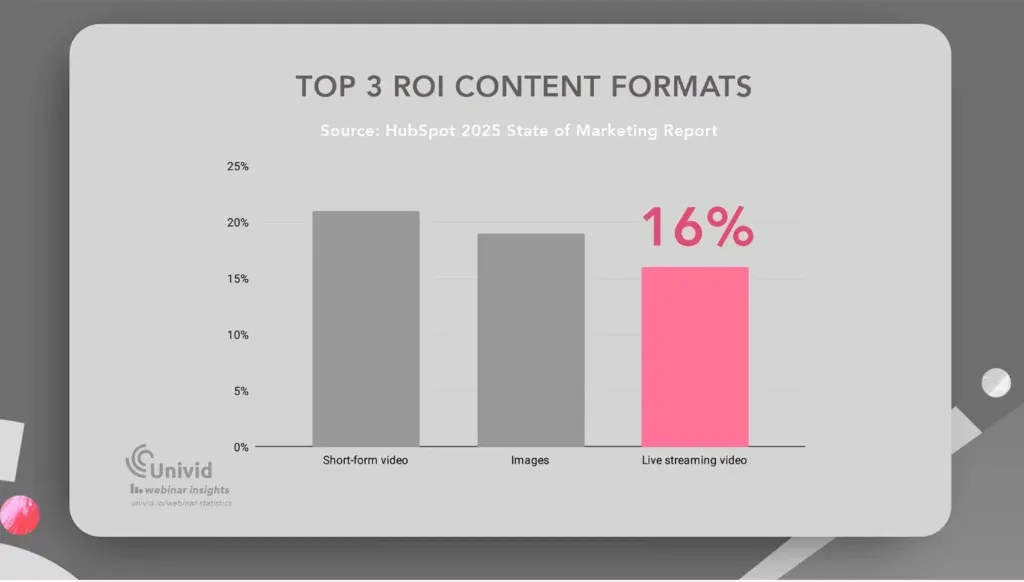
HubSpot backs up this trend: livestreaming ranks among the three content formats offering the best marketing ROI in 2025.
But while webinars remain a powerful lever, the context in which they’re used has become more demanding.
- In 2026, your prospects’ attention is the most contested resource on the web.
One figure is enough to show the scale of the phenomenon: back in 2007 (before social media, smartphones and streaming), a study by neuromarketing researcher Arnaud Pêtre already estimated that the average French person was exposed to between 1,200 and 2,200 ads per day. At the time, people spent an average of 2 hours a day online. Today, it’s more than 6 hours.
Add to that the 376 billion emails sent every day worldwide (Radicati Group, 2024), competing webinars, free masterclasses and replays: your prospects are constantly overloaded.
In this context, tolerance for mediocrity is close to zero. A webinar with no narrative tension, no interaction and no reason to stay until the end doesn’t just disappoint: it costs you sales. Your prospects are gone before you’ve even had time to present your offer.
- Expectations for the experience have gone up.
A laggy stream, an unreadable chat, an offer link buried in the comment feed: what was acceptable in 2019 no longer is. Your audience sees the quality of your tool as a signal of your professionalism. That’s also why 78% of webinar organizers now use a dedicated platform rather than a general-purpose streaming tool like YouTube Live. (Demand Gen Report).
- Competition is everywhere.
55% of B2B marketers have hosted at least one webinar in the past twelve months (Content Marketing Institute), and among infopreneurs, coaches and trainers, the format is even more widespread. Your audience has already seen plenty of live sessions. Standing out is no longer just about the quality of your content, but about the quality of the experience you create, from the waiting room all the way to the sales pitch. To see what your competitors are doing, Whoscale lists their webinar funnels.
The good news: those who understand these shifts find themselves in less crowded territory, with conversion rates higher than ever.
Webinar or VSL: which format for your sales funnel?
The VSL (Video Sales Letter) is the other major video sales format infopreneurs use. Before talking about tools and methods, the question is worth asking: do you really need to run a webinar? Or is a VSL enough?
The two formats take different approaches.
A VSL is a pre-recorded sales video, usually short (between 10 and 30 minutes), available at any time through an opt-in page.
A sales webinar, on the other hand, relies on length and interaction.
It lets you build trust gradually, answer objections in real time and create a shared moment that amplifies the decision effect. It’s a format that demands commitment from your audience and from you, but its conversion potential on premium offers remains hard to match.
So which one should you choose?
The answer mainly depends on the price of your offer and how mature your audience is.
- Under $500, a well-built VSL can convert effectively without requiring you to prepare a live session.
- Between $500 and $2,000, both formats can work, with an edge to the webinar if your audience doesn’t know you well yet.
- For offers above $2,000, the webinar is often the most effective format: at that price point, building the necessary trust is easier live, even though a well-designed VSL may be enough depending on the context and the audience.
One last point: VSLs offer little to no way to qualify your prospects individually. You know someone watched your video, but you don’t know which arguments made them tune out, or which objections still need to be addressed.
It’s precisely on this front – individual behavioral data – that the webinar gains a decisive edge for high-ticket offers.
How do you build a webinar that converts in 2026?
Live, evergreen or challenge: choosing the right format for your offer
A sales webinar is a complete sales system, one that starts well before the live session and continues well after it. Before getting into the details, there’s one foundational decision to make: choosing the format.
- Live remains the most powerful format for selling. The sense of occasion, the scarcity, the real-time interaction… Everything helps create the conditions for a purchase decision. It’s the format to favor when launching a new offer, testing a pitch, or selling to an audience that doesn’t know you well yet.
- Evergreen (or automated webinar) is the same content broadcast automatically at the dates and times you schedule. It scales without you being there, which makes it a passive income lever once the original live session has been optimized. It’s especially well suited to offers that have already proven themselves live. To choose between the two, read our live vs evergreen webinar comparison.
- The challenge is a sequence of several short sessions, usually over 3 to 5 days, that gradually leads your audience toward a purchase decision. It’s a more engaging format, but also more demanding to produce. It suits infopreneurs who already have an established audience.
On timing: in B2B, Tuesday, Wednesday and Thursday mornings remain the best-performing slots.
In B2C, Sunday at 6 p.m. or 8 p.m. stands out as the best time. Your audience is available, free from the work constraints of the week, and in a mindset more open to investing in themselves.
Preparing your webinar: defining the promise and the action plan
A sales webinar rests on an implicit contract with your audience: you provide value, they give you their attention.
Your prospects won’t give you 60 to 90 minutes out of mere curiosity, or to sit through a long sales pitch. They sign up because they expect to leave with something concrete.
Before you even structure your webinar, start by clarifying the value you want to deliver. Then, craft a clear promise, directly tied to the offer you’ll present at the end.
The more precise this promise is (specific, measurable and achievable within a given timeframe), the higher your registration rate, and the more your audience shows up with the right expectations.
Structuring your webinar: the 3 key stages of conversion
Webinars that convert all follow the same logic: an introduction that grabs attention, a flow that builds trust and a sales pitch that comes across as the natural next step.
- The introduction: grab attention and set the frame
The first few minutes of your live session are decisive. You have very little time to confirm to your attendees that they made the right call by signing up and to give them a reason to stay until the end.
An effective introduction usually includes:
- some context: explain how the webinar will run (length, when to ask questions, the order of the different parts).
- a reminder of the promise: spell out what attendees will learn or get by the end of the live session.
- a bonus or gift announced right at the start: content or a resource given away at the end to encourage attendees to stay until the very end.
- The flow: deliver value before you sell
Your registration promise is a commitment. If your attendees give 60 to 90 minutes to your webinar, it’s because they expect information, a method or an action plan.
Your priority is therefore to keep that promise before introducing your offer.
This is also the phase where the sale is gradually set up: your content should address your prospects’ limiting beliefs and main objections before your sales pitch.
Back up what you say with reassurance: client testimonials, results achieved, figures or data that strengthen the credibility of your claims.
- The sales pitch: turn attention into a decision
Your offer shouldn’t feel like a break in the webinar. It should come across as the logical continuation of what you’ve just demonstrated.
If the introduction framed the problem and your content showed that you understand your audience’s situation and have a proven solution, the pitch’s role is simple: present your offer as the most direct and accessible way to take action.
💡 Tip: to structure your pitch effectively, check out our dedicated article: How to nail your sales pitch.
Choosing your webinar platform: a strategic decision in 2026
You can have a strong promise, a well-thought-out structure and a perfectly prepared pitch. If your tech lets you down at the wrong moment (dropouts, lag, a broken chat), the whole balance of the webinar is compromised.
Your priority should therefore be to rely on a dependable tool built for sales webinars, so you can guarantee flawless technical stability during your live session.
But technical reliability is only the bare minimum. A good webinar tool should also drive your live session’s performance.
Ideally, it covers the three key moments of a webinar (before, during and after the broadcast) while boosting audience engagement, holding attention and making it easier to take action.
Most tools on the market (like YouTube Live, WebinarJam or Zoom) only cover part of these needs. They let you broadcast a webinar, but rarely offer all the features needed to engage the audience and support a real conversion strategy.
Welya.io: the webinar tool built for your conversion rates
The Welya webinar platform was created precisely to fill this gap.
Founded by Marvin Hannachi (Skors agency) after four years supporting the webinars of some of the most influential infopreneurs in the French-speaking market, the platform was designed with one clear goal: making every minute of your live session contribute to conversion. In 2026, it raised $200,000 from customers and partners, including Éric Larchevêque.
Before the live: turning the waiting room into an engagement lever
Even before the webinar starts, the interactive waiting room turns waiting time into a real activation lever.
- Videos,
- a dynamic countdown timer,
- a display of the number of connected attendees to amplify FOMO,
- polls and quizzes to get the audience involved…
Your attendees no longer wait passively; they’re already getting into an interactive mindset.
During the live: gamification and social proof to captivate your audience
During the live session, Welya includes gamification mechanics designed to hold attention over time.
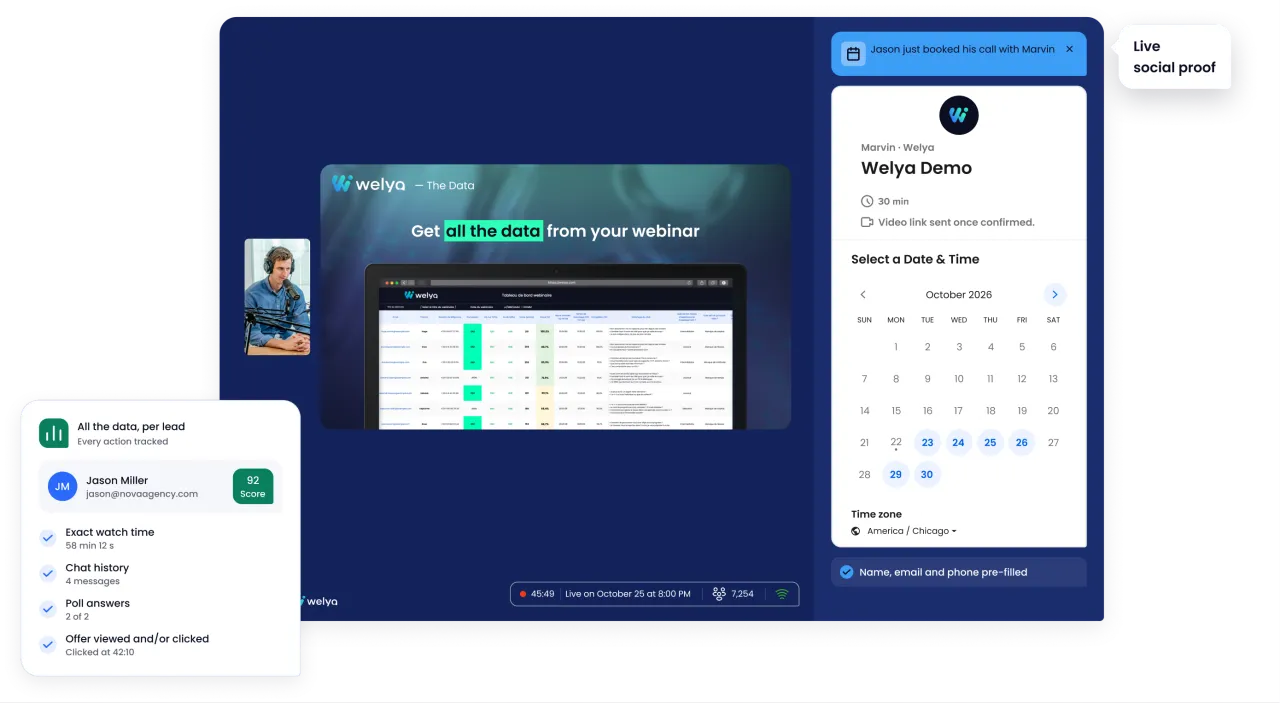
Attendees get a status shown in the chat, based on their engagement score, calculated from their interactions: messages, reactions or poll answers. The more engaged they are, the higher their score. This dynamic encourages participation and naturally limits drop-off, right up to the moment of the offer.
That moment is treated as the climax of the live session. The platform offers:
- Real-time sales notifications to create a bandwagon effect.
- Social proof pop-ups shown to all attendees when purchases are made.
- Live A/B tests on how your offer is presented, so you can test two versions in the same live session.
- Customizable exit pop-ups, designed to hold the attention of attendees who are about to leave the live session.
After the live: using data for highly targeted follow-ups
After the live session, Welya collects nearly 30 data points per attendee.
The activity curve gives you a minute-by-minute view of the moments that captured your audience, and the ones where engagement dropped.
Each attendee also gets an individual engagement score, calculated from their actual behavior: time present, interactions, clicks on the offer or questions asked.
By the end of the webinar, you have a prioritized list of qualified prospects.
Your follow-ups are no longer one-size-fits-all: they become targeted and personalized, focused on the profiles with the highest conversion potential. The result: your post-live sequences become more effective and replace generic follow-ups.
The platform also lets you switch to an evergreen format: you keep the same engagement mechanics and the same depth of analysis.
Conclusion: make webinars your growth lever with Welya
In 2026, the webinar remains one of the most effective formats for selling offers online. It brings together, at the same moment, the key elements of a purchase decision: attention, trust, value and timing.
But today, a simple live session is no longer enough. Audiences are more demanding, competition is fiercer and the margin for error is smaller. A webinar that is poorly structured, unengaging or poorly equipped doesn’t convert, and it represents a lost sales opportunity every single session.
The infopreneurs, coaches and trainers who get consistent results with this format have figured it out: a webinar that converts relies on both a solid structure and the right tools. Audience engagement, managing how the offer is presented, behavior analysis, targeted follow-ups: every step must be designed to maximize conversion. For real-world feedback, read Welya customer reviews.
That’s exactly the thinking behind Welya: a platform dedicated to sales webinars, designed to help you tap into the full conversion potential of every live session. To discover the platform, create your account and set everything up for free, no credit card required (a subscription is only needed to run a real live session): welya.io. And to go further, browse all our guides to selling with webinars.