
It’s the big day: the day of your webinar.
You’ve prepared your slides, rehearsed your introduction and delivered your content for 45 minutes. Everything is going well. Then comes the decisive moment: presenting your offer.
Suddenly, you start talking faster and your delivery gets choppier. On your screen, the number of attendees starts dropping: 150, 132, 110… The stress builds. You can feel yourself losing your audience. And deep down, you already know: there won’t be many sales tonight.
If this sounds familiar, you’re far from alone. For many infopreneurs, coaches and trainers, presenting the offer is the most dreaded moment, even though it’s the one where everything is decided.
So what makes a webinar sales pitch succeed (or fail)?
Follow this guide to learn how to structure a pitch that holds attention until the very last minute, keeps engagement high and leads your audience to a single conclusion: taking action.
Why does selling start with your webinar’s introduction?
The winning alignment: Promise > Value > Offer
Let’s start with one of the most common mistakes: treating the pitch as an aside at the end of the webinar.
In reality, selling doesn’t start when you present your offer, it starts in the very first minutes of your webinar. Your pitch should never come out of nowhere: it should feel like the natural continuation of everything you’ve presented.
In practice, your sales webinar content should already help your audience understand the problem your offer solves, why that problem exists and what the first steps are to start solving it.
Your offer is simply the fastest, safest and best-equipped vehicle to get there.
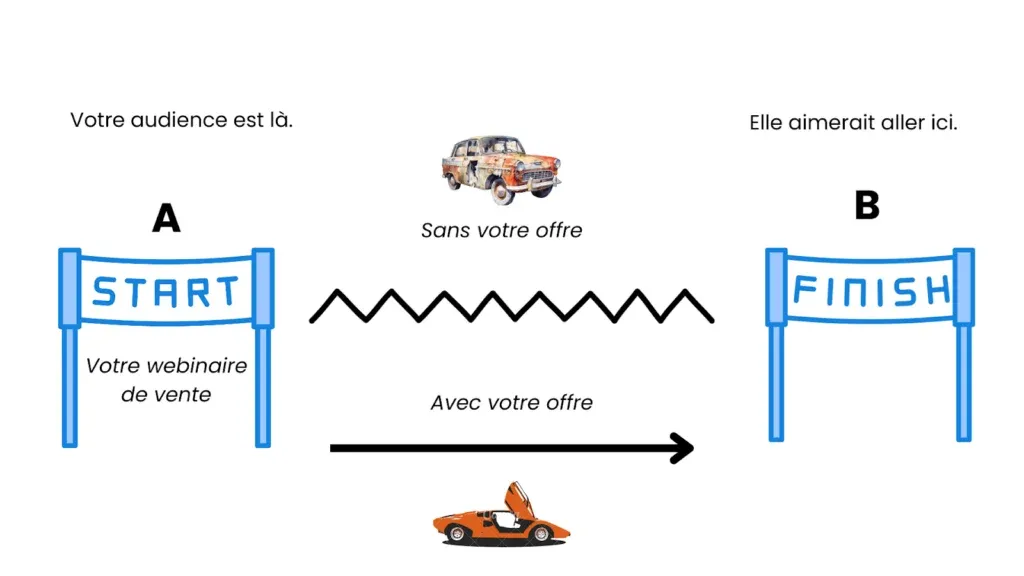
If the content > sales pitch transition feels difficult, it may be a sign of a lack of alignment between your webinar content and your offer.
The first step, then, is to build an offer directly tied to your audience’s problems, goals and needs.
Next, align your webinar’s promise with your offer’s promise.
Before you even organize your webinar, take the time to clarify these points:
- What specific problem should your webinar help people understand or solve?
- What transformation is your audience really looking for?
Why is your offer the best option for going further? What extra does it bring: faster results, support, a community, resources they can’t find anywhere else?
Delivering value: creating the aha moment before you present your offer
A webinar that converts always starts with value. Without it, there’s no attention, no trust and no desire to go further.
Your goal isn’t just to fill 60 minutes with generic advice. Your audience should leave with concrete ideas, a new understanding of the problem or a first shift in the way they think or act.
Value can take several forms:
- clearly explaining a problem your audience feels without always knowing how to put it into words;
- sharing a method, a framework or an actionable strategy;
- showing what really works, and what doesn’t.
The more useful and actionable your content, the more your credibility grows, and the more your audience understands that your offer is the logical next step.
It’s important to strike the right balance: give enough to spark an aha moment and demonstrate your expertise, without trying to solve the entire problem during the webinar.
The structure of an effective webinar sales pitch in 6 steps
Step 1: Use transparency to build trust
The worst mistake is trying to disguise a sales webinar as simple free content. Today, your audience is used to this format: they’ve already attended plenty of masterclasses, talks and webinars, and they know full well an offer will probably be presented at the end.
Rather than avoiding the subject, be transparent from the start. Simply announce that you’ll present an offer for those who want to go further. No need for a long speech: one sentence is enough.
This transparency does two things: it builds trust, and it psychologically prepares your attendees to hear an offer.
Step 2: Anticipate and address objections during your content
Handling objections is a job in itself, and ideally, it starts well before your webinar. Watching your competitors’ webinars with Whoscale can also help you spot your market’s objections.
If you haven’t done it yet, here’s a simple exercise:
Take a sheet of paper and write down every possible objection your audience might have to your offer: price, lack of time, lack of knowledge, doubts about results, fear of failing, the level required, etc.
Try to identify at least 40. (Yes, 40 at a minimum.) Then rank them from most critical to least important. This work lets you anticipate your audience’s resistance and address it naturally in your content.
Because in a sales webinar, an unaddressed objection is often a lost sale.
The good news is that most of these objections are predictable, and they can be handled well before the pitch.
The 5 big universal objections and how to answer them
| “I don’t have time.” | Depending on your audience and its priorities, show that your solution can fit into a busy schedule. Explain how it lets people make progress even with little time available. |
|---|---|
| “I can’t afford it.” | Help your audience put the investment into perspective. Compare your offer’s price with the cost of doing nothing, or with other solutions that are often longer and more expensive (school, training programs, bootcamps…). How much does this problem cost them every month if it stays unsolved? And how much would it cost them to fix it another way? |
| “It won’t work for me.” | Share testimonials or examples of people who started from a similar situation: the same constraints, the same starting point. |
| “I can do it on my own.” | Acknowledge that it’s possible. Then show what it really involves: more time, more trial and error, and often more mistakes before getting there. Your offer is the most effective way to reach their goals. |
| “I need to think about it.” | Give them a reason to act now: a bonus, a special price, a limited number of spots… Obviously, these must be real and justified (otherwise, say goodbye to your credibility.) |
If some objections remain after your presentation and your sales pitch, the Q&A session is there to handle them. Questions asked in the chat are just as valuable after the live session, to prepare closing calls.
This is the time to clear up anything still unclear, add details and create a direct exchange with attendees who are still on the fence. Every question is an opportunity to clarify the value of your offer and reassure your audience.
💡 Tip: to keep your presentation flowing, say at the start that questions will be handled at the end of the webinar. This avoids constant interruptions and lets you get through all of your content. In Welya, chat questions are flagged for your team, who can answer them privately.
Step 3: Use proof as a reassurance lever
One of the great strengths of a webinar is that you have time to build trust well before presenting your offer. Your presentation and content serve to establish that credibility, and proof remains the most effective way to get there.
Heads up, mini copywriting lesson (simplified version): there are 4 main types of proof to include in your webinar.
- Factual: what is indisputable, universal and obvious. For example: the laws of nature, human needs, physical limits, common behaviors, universal difficulties…
- Historical: what happened in the past. Events, previous results or how a situation has evolved.
- Mathematical: concrete, verifiable figures. Statistics, percentages, measurements or numerical comparisons…
- Social: what concerns other people. Testimonials, customer reviews, case studies or references to well-known behaviors.
Weave this reassurance throughout the webinar, not just during the pitch. To help you, here’s a handy table*:
| Webinar moment | Type of proof to use | Goals |
|---|---|---|
| At the start of the webinar | Factual, Social, Historical | Establish the credibility of your expertise and background. Answer the objection: “Who are you and why should I listen to you?” |
| While presenting your content | Factual, Historical, Mathematical | Reinforce the reliability of your advice. Show that your method works, that it’s proven and based on concrete data. Answer the objections: “Why do it this way and not another?” “Does it really work?” and “How does it work?” |
| After each part of your content | Social | Validate what you’ve just explained and build trust with testimonials and case studies. Answer the objection: “Have others succeeded with this?” |
| During your sales pitch | Social | Drive action by showing that others have already bought and gotten results. Answer the objections: “Why would it work for me?”, “Why should I buy now?” |
Screenshots, video clips, charts, quotes, statistics, interviews, case studies… Feel free to vary the formats of your proof depending on your presentation and what you have on hand.
*Of course, this can vary depending on your audience, the problem you’re addressing and the context of your webinar. Make sure you stay honest, never mislead your prospects and carefully check all your information.
What if you don’t have social proof yet?
It’s a very common situation, especially when launching a new offer, and it’s not as big an obstacle as people think.
If you already have a few clients or an active community, start there. Ask for feedback, even partial. An attendee who applied a single technique and got a first result is already proof.
A testimonial doesn’t need to be spectacular to convince; above all, it needs to be sincere and specific.
If your offer is brand new and you’re starting from scratch, lean on transparency. Just say it: it’s a launch, and you’re opening your first cohort. Far from weakening your message, this honesty often builds more trust.
In that case, support your message with other types of proof (see above).
The goal remains the same: show that your approach is built on something solid and proven. Client testimonials will come with your program’s first successes.
Step 4: Introduce your offer
At this point, you’ve aligned your content with your offer, set the frame in the introduction, handled the main objections and woven proof throughout the webinar. The groundwork is laid. Only one step remains: making a natural transition to your offer.
Remember: you’ve been transparent since the start of the webinar. Your audience knows an offer is coming. If your content is well built, much of the work is already done. At this stage, all you need is a natural transition. The same transition applies to an automated (evergreen) webinar.
- Start with a brief summary of the webinar’s key points.
- Then re-engage attendees with a simple question, for example: “Who here found what I just shared useful?”
- Follow with the introduction: “We’ve just covered [the why / the how] together. But you’re probably wondering how to [reach this result faster, more simply] without [the main difficulties].”
- Then ask permission to present your solution. For example:
“For those of you who are interested, and with your permission, I’m going to take a few minutes to present…”
This does two things:
- it naturally filters out people who really aren’t interested.
- it builds trust, because you’re implicitly asking for their consent before continuing.